20 February - 8 March 2026, at Coloma Castle (Sint-Pieters-Leeuw)
Jules Verne - The Secret Journey
Jens Hanke, Mathieu Zurstrassen, Petermfriess, Eddie Bonesire
Jules Verne - The Secret Journey
Jens Hanke, Mathieu Zurstrassen, Petermfriess, Eddie Bonesire
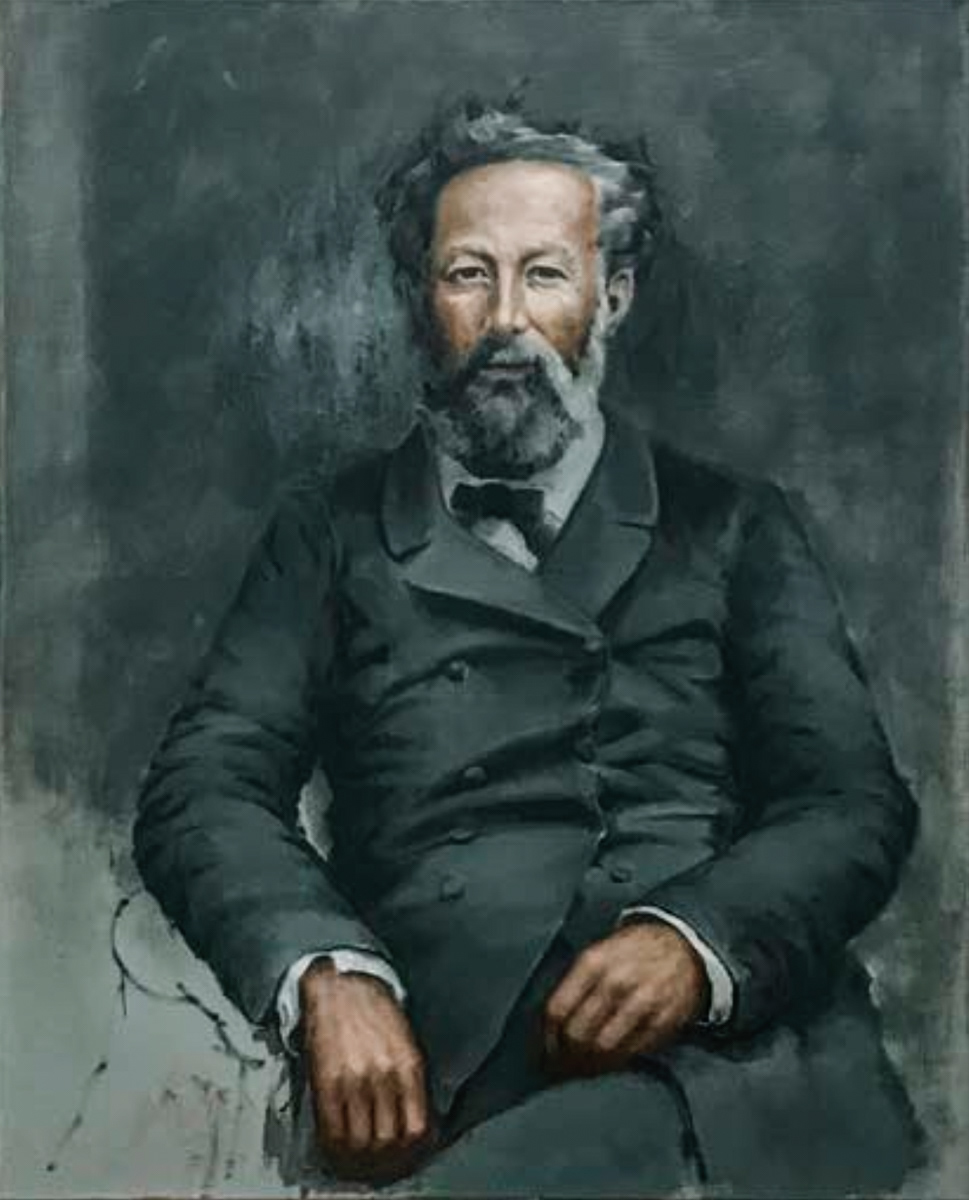
Jens Hanke, Portrait Jules Verne (2025), oil on canvas, 105 x 85 cm
During renovation work at Coloma Castle in Sint-Pieters-Leeuw, construction workers stumbled upon an old chest hidden behind a wall. Inside the chest was a yellowed manuscript that immediately piqued the interest of historians: it was the handwriting of Jules Verne – an unknown manuscript by the master. The title is: Le Voyage à travers la Pensée (The Journey Through the Mind), and it is the fascinating story of an expedition into the human brain. In a tiny capsule, the main character travels through the labyrinth of memories, past flickering thoughts and electrical impulses that shine like stars in an endless universe.
But how did this manuscript end up in the castle? Research led to Antoine van der Dilft de Borghvliet, a former lord of the castle and enthusiastic 19th-century scientist. Apparently, he had personally commissioned Jules Verne to write a story about the exploration of the mind - a subject that greatly interested him. The manuscript fell into oblivion until it resurfaced more than a century later.
Its content forms the basis for an exhibition that combines Verne’s fantastic vision with contemporary positions in the visual arts. Paintings, drawings, photographs, objects and installations partly using AI, are presented thematically in the ten rooms and attic of Coloma Castle and will invite visitors to travel through time and space experiencing unexpected auditive and visual encounters which expand Jules Verne’s scientific explorations into surreal landscapes and artificial, virtual realities, and will challenge existing perceptions.
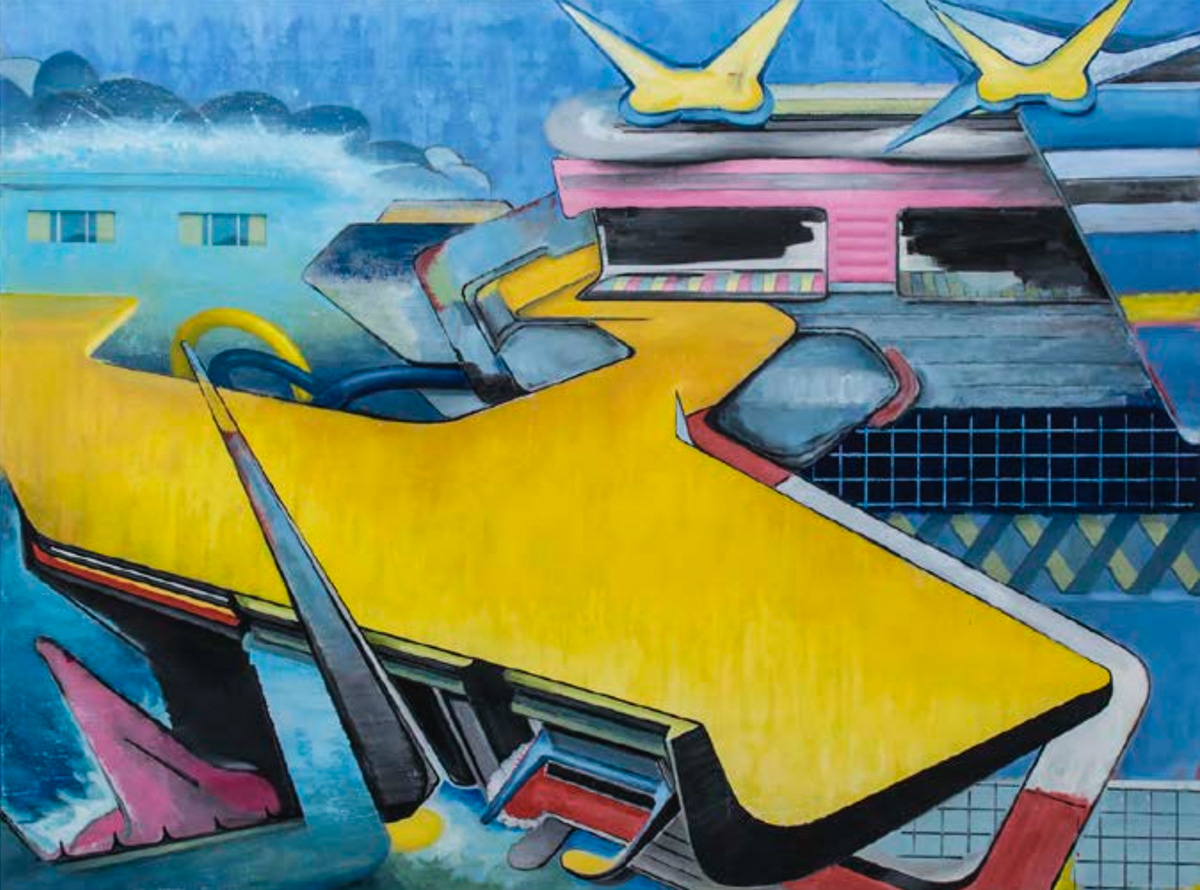
Jens Hanke, He Came Down and Left Again (2022), oil on canvas, 150 x 200 cm
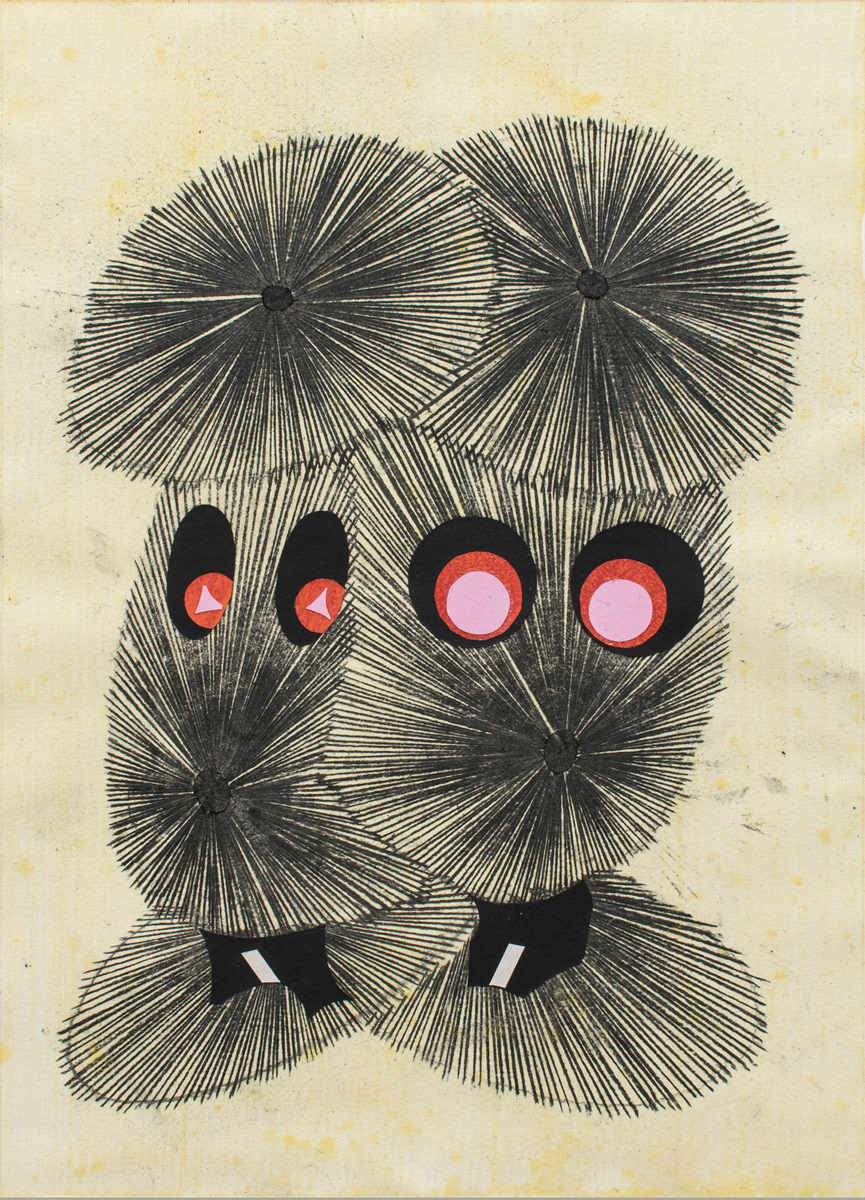
Jens Hanke, Being Hit by a Car (2022), charcoal on colour-primed paper, 38,5 x 28,5 cm
Jens Hanke uses mainly drawing and painting to dive into sci-fi inspired landscapes and funny creatures, which he calls ‘Sonderschaftler’. While starting from the original old manuscripts and some prints of the time, the visual language used in his paintings is inspired by abstraction and constructionism in very colourful and expressive compositions. In combination with his drawings from the series ‘Sonderschaftler’ and his sound and video installation, he creates a dream scenario aimed at opening up an imaginary space.
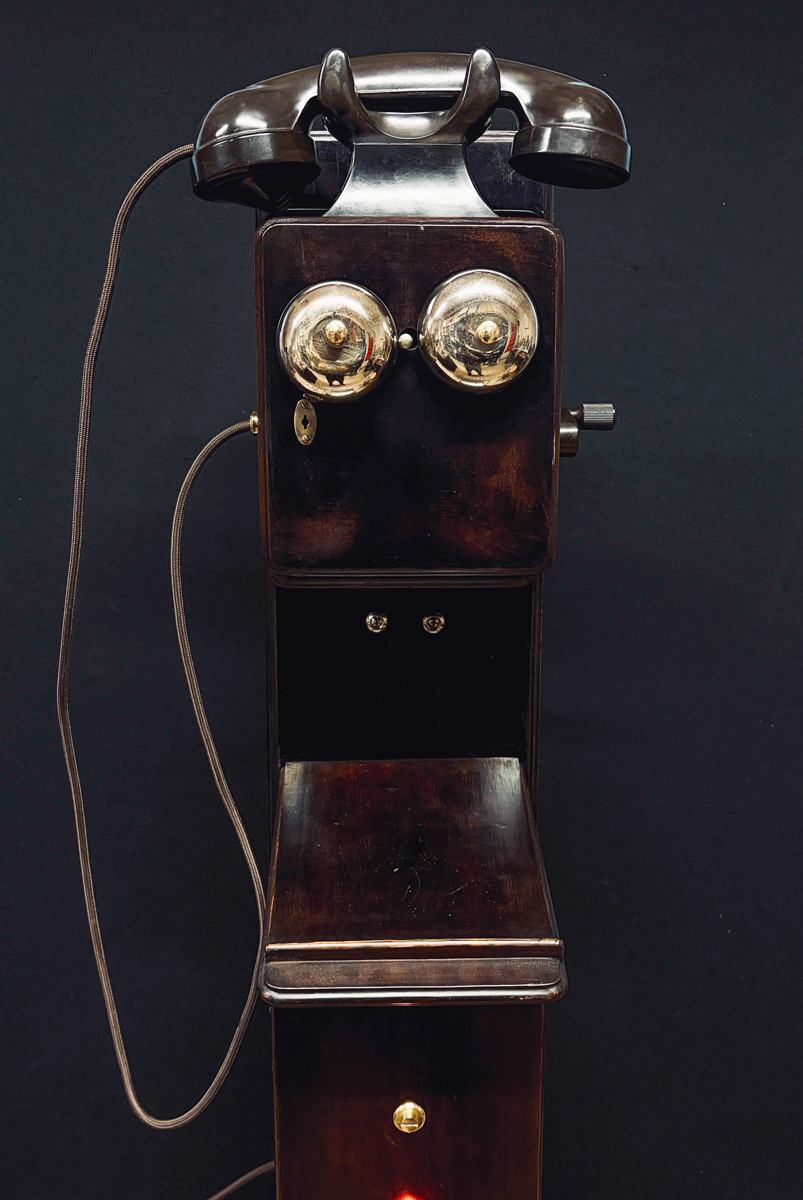
Mathieu Zurstrassen, Around the World in Eighty Calls (2026), steel, hand crank telephone, electronic components, 170 x 100 x 90 cm
Our journey into Jules Verne’s universe continues with Mathieu Zurstrassen’s sound and slide installations, which introduce a quite unique way of storytelling: rather than hearing a lecture of texts by Verne, we hear ambient sounds captured in the places he mentions in his novel Le tour du monde en quatre-vingt jours (Around the World in Eighty Days), through an old telephone; rather than seeing the texts, we see Braille signs on the slides shown with a translation into Braille of his Voyages Extraordinaires (Extraordinary Journeys). In both installations, Zurstrassen challenges visitors’ perceptions; words become images and sound, removing direct access and replacing it with another sense of cognition.
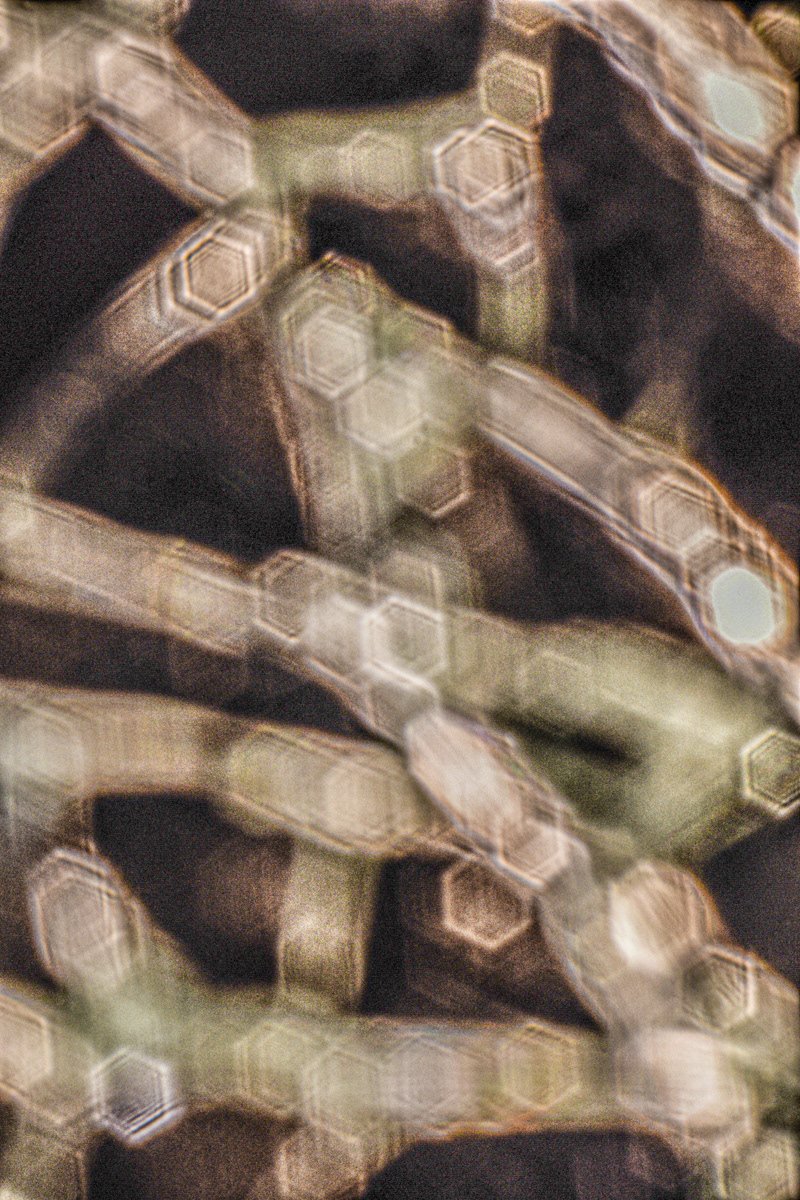
Eddie Bonesire, City Lights (2025) photography, 40 x 26,5 cm, pigment print on paper
Inspired by Verne’s text La Nuit, photographer Eddie Bonesire explores the effects of light. With light itself being at the centre of the series presented, both as agent and subject, visitors are confronted with abstract images which, by their fluid nature, leave room for free associations and imagination.
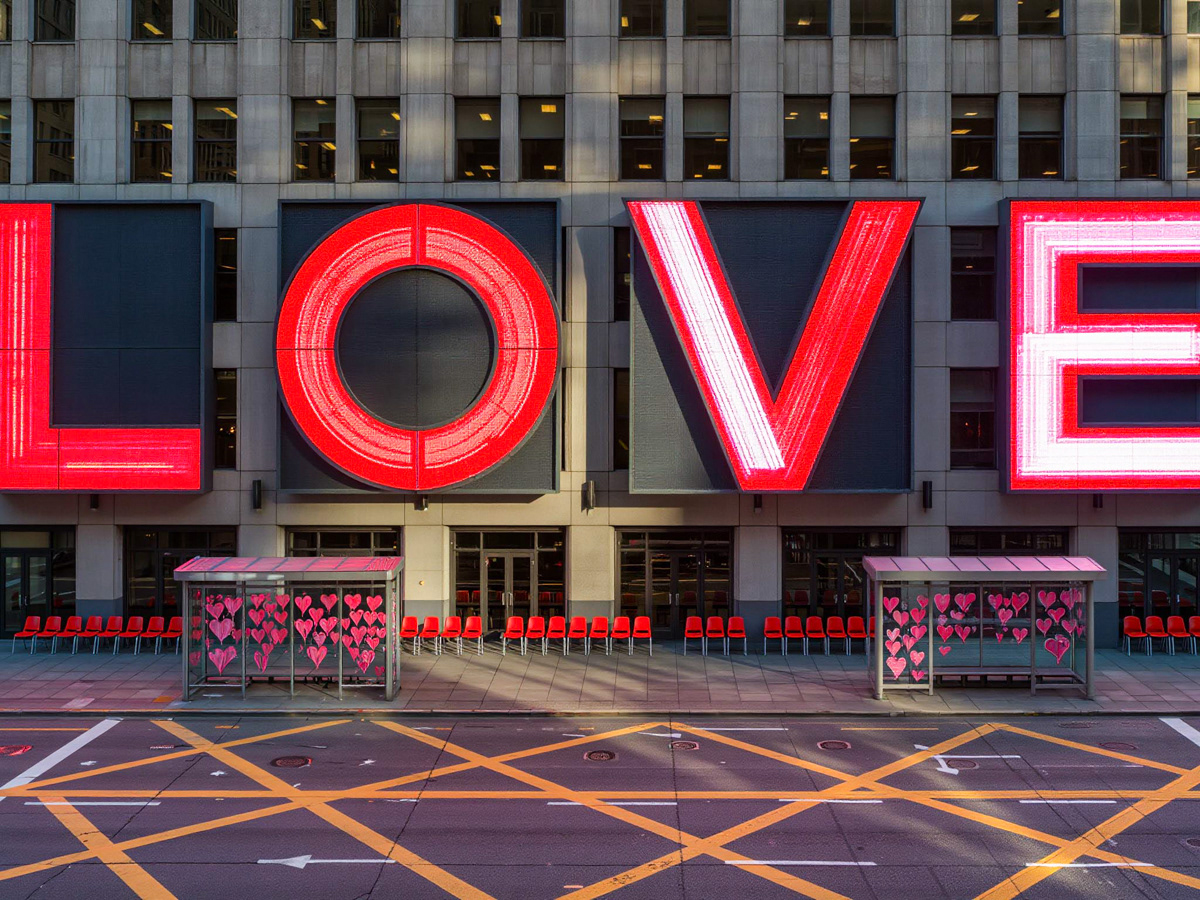
Petermfriess, SIGNAL 01 — PUBLIC DISPLAY (FRAGILE WE) (2025), digital print, AI-supported
Finally, Petermfriess’ AI-generated installations in form of video and sound attempt to transpose Jules Verne’s 19th century speculative brain atlas into a contemporary technology environment which finally removes all coordinates to become self-generated by the machine, exposing visitors to a flood of sound and image frames involving all types of contemporary circumstances.
CV's:
Eddie Bonesire was born in Ghent in 1956. He lives and works in Brussels and Ahrenshoop. Having an MA in Translation/Interpreting (ILMH/UCLouvain), he worked in various language-related professions, before devoting himself entirely to art-related projects.
Initially a self-taught photographer, he later studied photography at the Ostkreuzschule für Fotografie in Berlin-Weissensee, in the postgraduate master class (Meisterklasse) of Prof. Ute Mahler and Ingo Taubhorn. As a photographer, his areas of interest include political and social history, city and landscape, and experimental photography.
So far, his work has been shown in Belgium, France, Germany, Great Britain, Italy, the Netherlands, Norway and Spain.
www.ebonesire.net
Initially a self-taught photographer, he later studied photography at the Ostkreuzschule für Fotografie in Berlin-Weissensee, in the postgraduate master class (Meisterklasse) of Prof. Ute Mahler and Ingo Taubhorn. As a photographer, his areas of interest include political and social history, city and landscape, and experimental photography.
So far, his work has been shown in Belgium, France, Germany, Great Britain, Italy, the Netherlands, Norway and Spain.
www.ebonesire.net
Petermfriess is a Brussels-based media artist, independent researcher and curious mind working across Europe. With a background in space engineering and a PhD on self-organising social systems, he connects engineering thinking with systems theory and social analysis. His training in visual composition with Peter Paulwitz-Matthäi in Hamburg continues to shape his artistic practice to this day.
He is active as an artist, writer, lecturer, curator, traveller and policy maker. His work operates at the intersection of art, technology and society, with a particular focus on artificial intelligence, mixed realities and beyond-human or non-human life forms. His projects have been shown worldwide at festivals, in exhibitions and at conferences. Alongside installations, performances and speculative image series, Petermfriess publishes essays and lectures on topics such as AI, the metaverse and transhumanism.
www.petermfriess.com
He is active as an artist, writer, lecturer, curator, traveller and policy maker. His work operates at the intersection of art, technology and society, with a particular focus on artificial intelligence, mixed realities and beyond-human or non-human life forms. His projects have been shown worldwide at festivals, in exhibitions and at conferences. Alongside installations, performances and speculative image series, Petermfriess publishes essays and lectures on topics such as AI, the metaverse and transhumanism.
www.petermfriess.com
Jens Hanke was born in Eilenburg (Germany) in 1966. He studied at the Leipzig Academy of Fine Arts (HGB). In 1994, he received a DAAD scholarship to study in Chicago, USA, where he stayed for six years. Since 2000, he has been living and working in Berlin.
Hanke’s work has many associative meanings. He is concerned with the phenomenon of perception as a psychological process. He uses elements of modernism and surrealism and weaves them into a visual network of different pictorial worlds. His layered work includes drawings, books, collages, paintings and large wall installations.
His work has been shown in many solo exhibitions in Germany, Switzerland and the USA and can be found in numerous private and public collections.
www.jenshanke.de
Hanke’s work has many associative meanings. He is concerned with the phenomenon of perception as a psychological process. He uses elements of modernism and surrealism and weaves them into a visual network of different pictorial worlds. His layered work includes drawings, books, collages, paintings and large wall installations.
His work has been shown in many solo exhibitions in Germany, Switzerland and the USA and can be found in numerous private and public collections.
www.jenshanke.de
Mathieu Zurstrassen is a trained architect who transitioned to the field of visual arts in 2013, channelling his understanding of structure and design into an experimental practice. Moving beyond traditional architectural drawing, his work emphasizes the process of construction as a form of exploration, where materiality and technique become tools for storytelling and critical reflection.
Deeply rooted in today’s societal habits, Zurstrassen’s work serves as a mirror to contemporary life, questioning our relationship with technology, consumption, and the invisible systems that underpin our daily routines. Highly technical yet profoundly human, Mathieu Zurstrassen creates pieces that are as much about engineering as they are about emotion, using humour and subtle irony to challenge and engage the viewer.
He has exhibited in various events, galleries and festivals such as the KIKK Festival, Ars Electronica or Venice Biennale.
www.mathieuzurstrassen.com - www.zurstrassenkinetics.com
Deeply rooted in today’s societal habits, Zurstrassen’s work serves as a mirror to contemporary life, questioning our relationship with technology, consumption, and the invisible systems that underpin our daily routines. Highly technical yet profoundly human, Mathieu Zurstrassen creates pieces that are as much about engineering as they are about emotion, using humour and subtle irony to challenge and engage the viewer.
He has exhibited in various events, galleries and festivals such as the KIKK Festival, Ars Electronica or Venice Biennale.
www.mathieuzurstrassen.com - www.zurstrassenkinetics.com